

Sunflower Without Herbicides – Practical and Profitable!
06/16/2026
How the management of Diar Agricultural Enterprise in Kyiv Region improved sunflower and corn production technology with the BEDNAR ROW-MASTER row-crop cultivator
Long before the outbreak of the full-scale war and the economic challenges that followed, Ukrainian agricultural producers were actively searching for practical ways to reduce crop production costs while minimizing the impact of chemical products on crop health and soil fertility.
First of all, herbicides represent a significant production expense, and their prices continue to rise year after year. In sunflower and corn cultivation, herbicide applications can add several thousand hryvnias per hectare to annual production costs.
Secondly, herbicides do not always perform exactly as expected, despite following the manufacturer's recommendations. Their effectiveness depends on numerous factors, including soil moisture conditions, spray application quality, and the presence of herbicide-resistant weeds. However, perhaps the greatest concern is the phytotoxic effect that herbicides may have on cultivated plants, potentially slowing their development. In addition, growers often face the issue of herbicide carryover, which can negatively affect subsequent crops in the rotation.
The most obvious alternative to chemical weed control is thorough and timely mechanical soil cultivation. Stimulating weed and volunteer crop emergence in the autumn, followed by pre-sowing cultivation in the spring and the use of rotary and tine harrows, can deliver excellent results.
The most obvious alternative to chemical weed control is thorough and timely mechanical soil cultivation. Stimulating weed and volunteer crop emergence in the autumn, followed by pre-sowing cultivation in the spring and the use of rotary and tine harrows, can deliver excellent results.
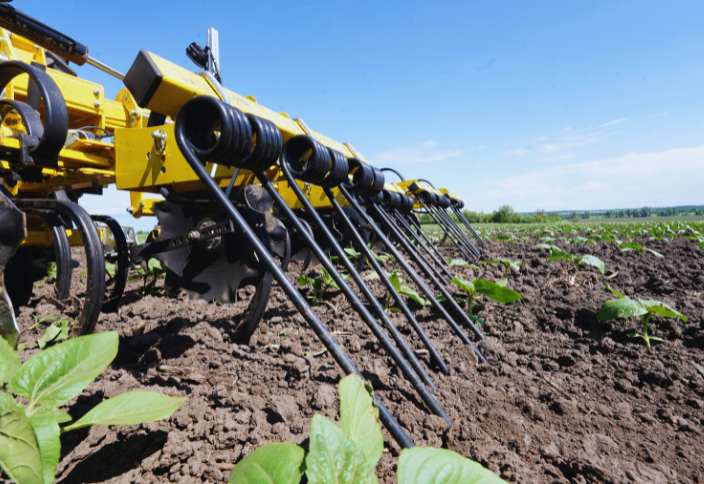
Nevertheless, weeds continue to emerge throughout the growing season, wave after wave. This is why row-crop cultivators are an extremely effective solution for sunflower and corn production. These machines literally clean the inter-row spaces of unwanted vegetation, leaving behind loose, well-aerated soil.
However, conventional row-crop cultivators have their drawbacks, the most significant being the risk of damaging or cutting cultivated plants within the rows. Naturally, no grower wants such “assistance” if it means losing 10% or more of a sunflower or corn crop—and paying for it at the same time.
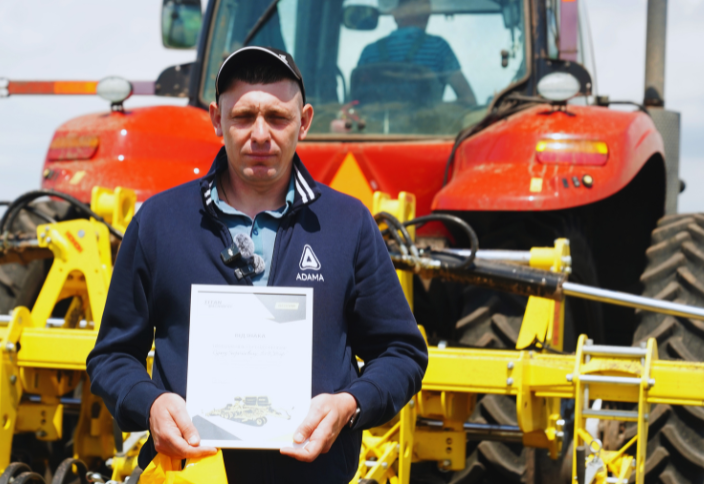
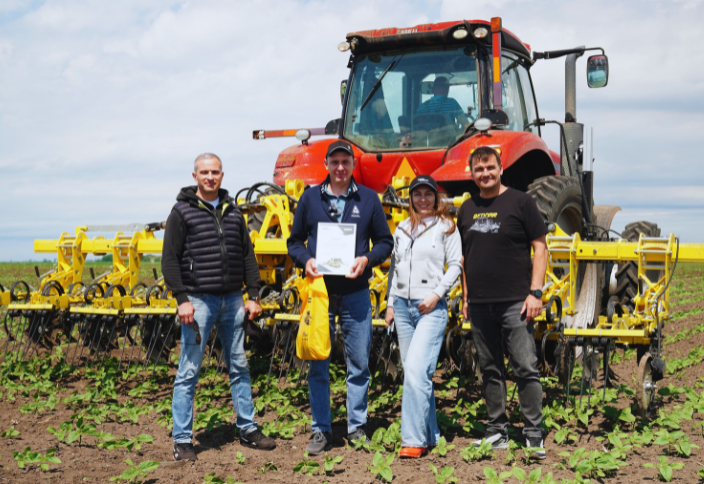
Fortunately, agricultural technology continues to evolve. Today, Ukrainian farmers have access to proven solutions that eliminate the traditional disadvantages of row-crop cultivation while preserving all of its agronomic benefits. One such solution was adopted by Diar Agricultural Enterprise, located in the Bila Tserkva district of Kyiv Region. The company purchased what can truly be described as a unique machine from Тайтен Машинері Україна—the BEDNAR ROW-MASTER RN6400 equipped with an automatic row-guidance system. To learn more about the machine and its performance in the field, we spoke with the farm’s Chief Agronomist, Maksym Yakubovych.
It is worth noting that Diar Agricultural Enterprise cultivates 1,600 hectares of land, growing winter wheat, winter barley, winter rapeseed, sunflower, corn, and peas. As we can see, the crop rotation is quite diverse, while the soil management system follows a conventional approach based on mouldboard ploughing combined with deep soil loosening and simultaneous field surface levelling.
“Honestly, we have long been convinced that minimum-tillage technologies are not the best fit for our conditions. Fortunately, we do not face critical rainfall shortages, which allows us to prepare the soil properly. This creates favorable conditions for crop emergence and development and gives us the opportunity to achieve solid yields. Of course, every season is different, but the key principle for us is that we must first rely on our own efforts before blaming the weather,” says Maksym Yakubovych.
“Honestly, we have long been convinced that minimum-tillage technologies are not the best fit for our conditions. Fortunately, we do not face critical rainfall shortages, which allows us to prepare the soil properly. This creates favorable conditions for crop emergence and development and gives us the opportunity to achieve solid yields. Of course, every season is different, but the key principle for us is that we must first rely on our own efforts before blaming the weather,” says Maksym Yakubovych.
According to Mr. Yakubovych, crops such as sunflower and corn play a significant role in the farm’s profitability. Therefore, together with his colleagues, he is continuously working to improve the technologies used for their cultivation.
“If weed control is not properly addressed, neither high-quality seed, nor fertilizers, nor fungicides and insecticides will deliver the desired result. Of course, what appears to be the easiest solution is to ‘cover the field with chemistry’—first applying a pre-emergence herbicide and then, if necessary, a post-emergence treatment. However, to be honest, this approach is not particularly attractive to us. It means additional and quite substantial costs, unnecessary stress for the crops, which already have to cope with increasingly challenging climatic conditions, and a negative impact on the environment and soil biology,” explains the chief agronomist of Diar Agricultural Enterprise.
It is therefore no surprise that the farm has long practiced inter-row cultivation in sunflower and corn crops. Initially, this work was carried out using conventional row-crop cultivators of the KRN type.
“What can I say? A KRN cultivator is a KRN cultivator. Yes, these machines helped us, but you had to put a highly skilled operator in the tractor cab, and even then crop damage and plant cutting were unavoidable. As a result, we had no choice but to leave approximately 10 centimeters of uncultivated soil on each side of the row; otherwise, the losses would have been so significant that it would have been difficult to say whether the weeds or the cultivation itself caused greater harm. In other words, the efficiency of conventional row-crop cultivators was relatively low. We finally solved this issue by purchasing the Czech-made BEDNAR ROW-MASTER RN6400,” recalls Maksym Yakubovych.
Technical Overview
BEDNAR ROW-MASTER RN Row-Crop Cultivators
Technical Overview
BEDNAR ROW-MASTER RN Row-Crop Cultivators
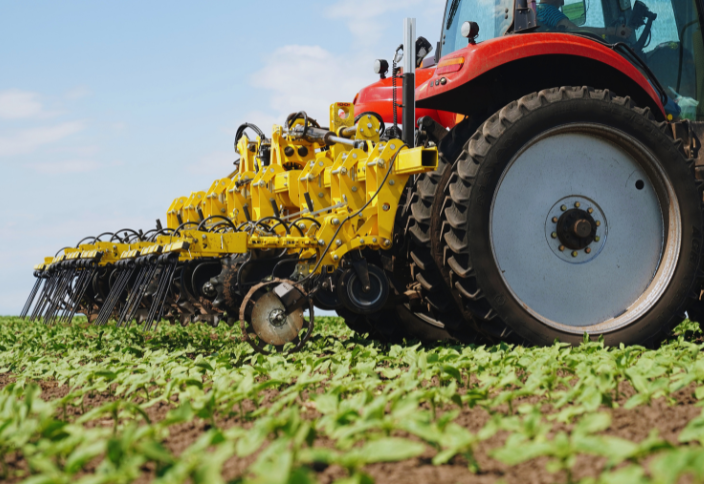
The BEDNAR ROW-MASTER RN row-crop cultivator is designed to operate in row spacings ranging from 45 to 80 cm. The machine is available in three working widths—4.8 m, 6.4 m, and 9.6 m—and requires tractor power from 80 to 150 hp, depending on the model configuration. Working speeds of up to 18 km/h can be achieved under suitable field conditions.
The BEDNAR ROW-MASTER RN can be equipped with a range of working tools, including standard cultivator sweeps, chisels, and hilling shares. The cultivator units are mounted to the frame via a parallel-linkage system, allowing the machine to accurately follow field contours while maintaining a consistent working depth. This design also eliminates unwanted lateral movement caused by uneven terrain.
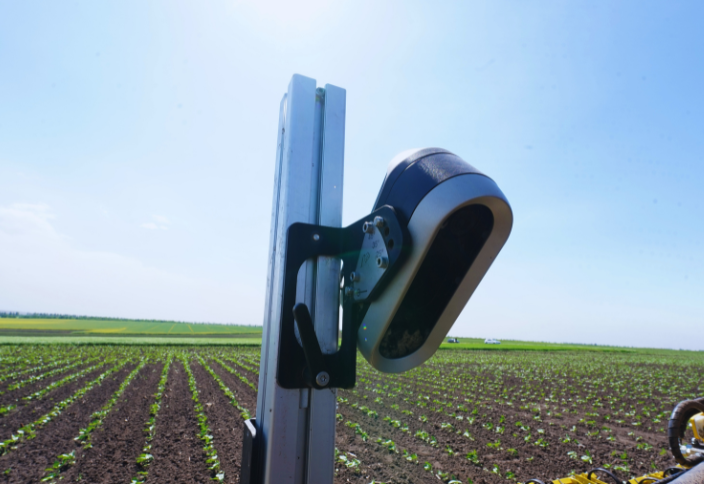
The machine can be equipped with the CultiCam optical guidance system, which automatically steers the cultivator and keeps it precisely aligned with the crop rows. As a result, the implement operates independently of minor deviations in the tractor’s path, significantly reducing the risk of crop damage. The advanced CultiCam PROFESSIONAL package automatically adjusts camera height and angle, recognizes multiple colors (red, yellow, blue) and their combinations, and can detect crop height for enhanced guidance accuracy.
In addition, the ROW-MASTER can be fitted with a BEDNAR fertilizer hopper, enabling localized fertilizer application during cultivation operations.
The key feature that distinguishes this model is its CultiCam optical guidance technology. Simply put, the cultivator does not merely follow the tractor’s trajectory; instead, it is continuously guided by intelligent cameras that keep it accurately centered between the rows, ensuring that crop plants remain untouched and undamaged throughout the operation.
“If we compare it with the KRN cultivators we used before, we were forced to leave almost half of the inter-row area untreated. With the BEDNAR ROW-MASTER, the sweeps operate as close to the sunflower or corn rows as possible. As a result, virtually the entire inter-row space is cleared of weeds. Only a small amount of weed growth may remain directly within the crop row. However, we eliminate this issue during the second pass with the BEDNAR ROW-MASTER by replacing the rear sweep with a hilling attachment, which covers the weeds with soil. As a result, by harvest time our sunflower fields were completely free of weeds,” notes the chief agronomist of Diar Agricultural Enterprise.
“If we compare it with the KRN cultivators we used before, we were forced to leave almost half of the inter-row area untreated. With the BEDNAR ROW-MASTER, the sweeps operate as close to the sunflower or corn rows as possible. As a result, virtually the entire inter-row space is cleared of weeds. Only a small amount of weed growth may remain directly within the crop row. However, we eliminate this issue during the second pass with the BEDNAR ROW-MASTER by replacing the rear sweep with a hilling attachment, which covers the weeds with soil. As a result, by harvest time our sunflower fields were completely free of weeds,” notes the chief agronomist of Diar Agricultural Enterprise.
This is how the system works—simple in concept, yet highly sophisticated in execution. For the second consecutive season, this intelligent and technically advanced row-crop cultivator has enabled the farm to fully solve its weed-control challenges in sunflower production, and potentially in corn as well.
“Last year, on 400 hectares of sunflower, we did not apply either pre-emergence or post-emergence herbicides at all. We calculated the costs and found that two passes with the BEDNAR ROW-MASTER—the first shortly after crop emergence and the second at the 8–10 leaf-pair stage—cost us several times less than a conventional herbicide program. At the same time, we avoid chemical stress on the crop and eliminate unnecessary chemical impact on the soil. Fuel consumption during cultivation is only 5 liters per hectare per pass. Add the operator’s wages and equipment depreciation, and that is essentially the entire cost,” smiles Maksym Yakubovych.
The eight-row BEDNAR ROW-MASTER RN6400 purchased last year has already cultivated approximately 1,500 hectares, primarily in sunflower and corn fields.
“In real field conditions, during the first pass at a working speed of 8–9 km/h, the machine covers around 35 hectares in a 10-hour shift. During the second pass, we can increase the speed to 11–12 km/h and average about 45 hectares per shift. By comparison, a conventional cultivator of a similar working width allowed us to cover no more than 30 hectares per day. This clearly demonstrates the key advantages: no crop damage, no chemical stress, high operational productivity, and effective soil loosening that improves aeration and access of oxygen to the crop root system,” explains the chief agronomist.
According to Mr. Yakubovych, once the sunflower crop reaches the 8–10 leaf-pair stage, the BEDNAR ROW-MASTER leaves him with a field that is virtually free of weeds.
“At that point, we can confidently apply fungicides, insecticides, and micronutrients. Combined with the positive agronomic effects of inter-row cultivation, the results are immediately visible—the plants are noticeably healthier and more vigorous. It is therefore not surprising that, even during last season, which was far from ideal for sunflower production in our region, we achieved an average yield of 3.2 t/ha. And we did so with significantly lower production costs,” he emphasizes.
Maksym Yakubovych also notes that an additional benefit of purchasing the BEDNAR ROW-MASTER RN6400 was the high-quality after-sales support provided by Titan Machinery Ukraine, the official dealer of BEDNAR equipment.
“Everything has been excellent. The machine was demonstrated on our farm during the summer, and the specialists explained every detail of its operation. We evaluated the results and decided to purchase the cultivator for the following season. We selected the same specification that had been demonstrated to us and was available at the time. The Titan Machinery Ukraine team handled all the setup and training, showing us exactly how to operate the machine, and since then we have experienced no issues whatsoever with our BEDNAR ROW-MASTER. In fact, we still have not replaced the working tools, despite the machine having covered a substantial acreage under demanding conditions. Our next step will be to order a dedicated fertilizer hopper for the cultivator so that we can simultaneously apply granular or liquid fertilizers directly into the soil during inter-row cultivation. I believe this will make the technology even more efficient,” concludes Maksym Yakubovych, Chief Agronomist of Diar Agricultural Enterprise.